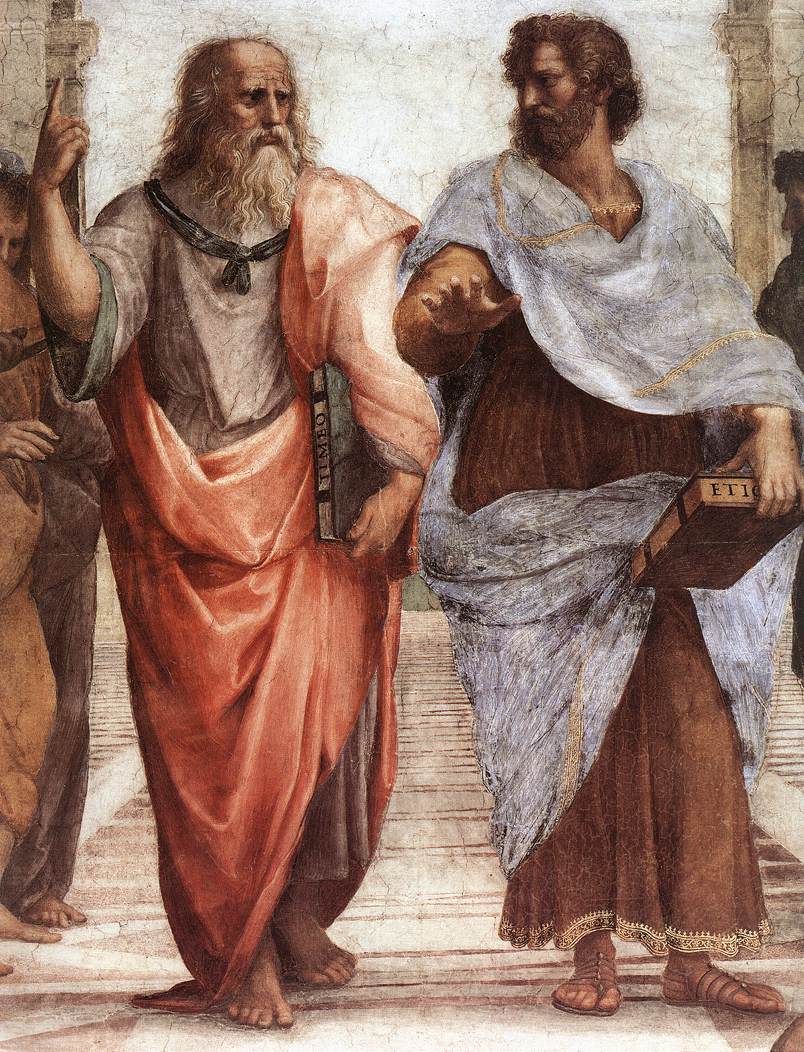
Girl: I have some homework to do. I have to read Plato's Republic before five.
Guy: Why five?
Girl: I want to finish before my ballet class.
Now, this is a pretty harmless conversation, right? But it made me think. You know, the guy probably didn't know much about Plato's Republic. (I'm making an assumption here, but by the sound of it, he didn't.) Heck, I don't even know much about Plato's Republic. But did the guy want to find out? Did the girl think about the reading as more than just a box to check off her to-do list? Though I could be wrong, the answer to both questions, judging by their attitudes, seemed to be no. That's all well and good, of course. This was just small talk between a boy and a girl as they walked home from school. So why did it bother me? Well, I'll tell you.
The reason it bothered me is that I can't help thinking that we students have somewhat lost our sense of intellectual curiosity and ability to generate deep, meaningful conversations about the ideas that make up our identity as individuals, a civilization, and the human race.
I myself, of course, am blatantly guilty of shallow conversation sometimes. If you run into someone while you're trudging home from school, exhausted after a long day of classes, you probably don't have the energy for deep, philosophical thought. I understand how that goes, and I'm not saying that all our conversations have to revolve around philosophical musings. But I think we're missing out on a lot of interesting, stimulating, even life-changing conversations so many times because we don't think deeply enough, we don't share what we learn, and we don't ask the right questions of other people. What if the guy had asked the girl what she had learned about Plato's Republic so far? What if he asked her why she was reading it? (Not just looking for the answer "For a class,"but the rationale, the premise.) What if both of them had the expectation and willingness to engage in deeper, more thoughtful conversation?

But this is precisely what concerns me. It concerns me that I see the mindset so prevalent that we're going to school pretty much just to get a better-paying job, skills, and arbitrary knowledge that will hopefully help us somewhere along the line. Eventually we want to share what we learn through application in the marketplace and in our homes, but why in the world can't we start sharing now? Why can't we be engaging this information more thoroughly, seeking out opportunities to learn more, and finding people to converse with who would have something interesting to say on the subject? Well, it's because we're not trained to think that way.
Let me illustrate with an example. Remember those darn college application essays with the sometimes funky questions? Why are those so hard? Questions like, "If you could be any animal, what would you be and why?" (Real interview question for a graduate school my roommate is applying to right now.) They're hard because we haven't trained ourselves to think along those lines. We haven't practiced that kind of analysis and reflection on a regular basis, both formally and in informal conversations with our friends and associates.
This mindset of intellectual curiosity is called critical thinking, and you've probably heard the term from your English teacher a time or two. But critical thinking is not just something you do once in awhile when you're writing an essay--it's a mindset you have to cultivate. And I would venture so far as to say that you must cultivate that mindset in order to get the most out of your college education.
Plato founded the Academy of Athens, the first institution of higher learning in the Western world. Higher learning developed because people wanted to gather together not only to gain knowledge, but to discuss it, to argue, to form their own opinions, to teach what they learned to others both formally and informally. Thus, I challenge you to rekindle the intellectual fire of this tradition. I challenge you to learn not only to do well on the test, but to share something you learned in an intelligent conversation this month, this week, or this afternoon. Because frankly, learning in a vacuum does no good. You have to share it. And doing things like writing a paper, turning it in, and forgetting about it without talking about your ideas with anyone is about as vacuum-like as you can get.
And guess what?
If you approach education like that, it's a waste!
Rubbish!
Useless!!!
You might as well not go to school at all if you don't engage those ideas in another way--if you don't learn, if you don't internalize, if you don't SHARE.
So think deeper. Make connections. Form your own opinions. Take your ideas seriously. And don't be afraid to ask people deeper questions and give thoughtful answers. Join in and be an active participant in this great conversation of mankind.


1 comments:
It is the "wall of text" phenomenon in the modern days.
Nobody wants to read something if it doesn't interest them from the start.
In essence, it all comes down to "tl;dr" or "too long, didn't read" attitude.
Post a Comment